CLICK HERE FOR FREE BLOGGER TEMPLATES, LINK BUTTONS AND MORE! »
Showing posts with label contemporary. Show all posts

Monday, June 18, 2012

The Fine Art of Truth or Dare

Publisher: Penguin (Speak)
Pages: 380

Publication Date: February 16, 2012
Type: Paperback, received as gift

Pretty in Pink meets Anna and the French Kiss in this charming romantic comedy

Ella is nearly invisible at the Willing School, and that's just fine by her. She's got her friends - the fabulous Frankie and their sweet cohort Sadie. She's got her art - and her idol, the unappreciated 19th-century painter Edward Willing. Still, it's hard being a nobody and having a crush on the biggest somebody in the school: Alex Bainbridge. Especially when he is your French tutor, and lessons have started becoming, well, certainly more interesting than French ever has been before. But can the invisible girl actually end up with a happily ever after with the golden boy, when no one even knows they're dating? And is Ella going to dare to be that girl?


*~*~*~*~*~*~*~*~*~*~*~*~*~*~*~*~

A lot of good and a lot of bad.

This book has a fair amount going for it.  The writing is good; intelligent and cute and clear.  The premise is intriguing and adorable.  Both the concept and the execution of the Truth or Dare games were fantastic--it added a really wonderful dynamic to the trio's friendship, and to the story as a whole.  And as for the trio itself, I was very pleasantly surprised by our protagonists's best friends. When they were first introduced, I cringed quite a bit; they seemed destined to be nothing but flat, irritating stereotypes.  However, as the novel progressed, the two became shockingly three-dimensional, likable characters--more likable than the protagonist herself.  Also, I really enjoyed the strong presence of family in this novel, even if Ella's relatives occasionally bordered on stereotypical.

And, since this is a romance at heart, I'd be remiss if I didn't mention the love interest himself.  I expected Alex Bainbridge to be the typical rich, hot jackass, so I was again pleasantly surprised when he turned into quite the likable character.  While at times his behavior really irritated me, he was funny and sweet and even a bit nerdy, and I grew quite fond of him.

Sadly, that's where the positives stop.  And sadly, my very first and biggest negative is the protagonist herself.

I did not like Ella. I did not connect with Ella.  I did not sympathize with Ella.  And that made this novel significantly harder to enjoy.  There were a few occasions where she acted admirably, or said something witty, and I would smile and nod and think, perhaps there is some hope!  But then she'd go back to being shy and self-deprecating and creepy, and the positive feelings would all bleed away.

Ella brings nothing new to the table, not even her disturbing obsession with a dead guy named Edward--it's all been done before!  She's quiet, awkward, self-conscious, constantly belittling herself, constantly wondering oh-why-oh-why could someone like him ever want someone like me.  And worst of all, she's obsessed with an artist that died over a century before.  When I say obsessed, I don't mean she really loves his artwork and is fascinated by his life story.  I mean she imagines that she holds conversations with him, and even thinks of him in a romantic light.

I think that was supposed to be cool and quirky, but it just creeped me the fuck out.

And that sort of leads into my other major problem with this novel: we were supposed to think she was the absolute coolest.  We were supposed to think that /quirky/ Ella and her friends are just the absolute best and all these hot, bitchy, completely one-dimensional popular kids are the worst thing to ever grace this earth.  I mean, G-d forbid you actually give the popular people . . . personality.  Or . . . complexity.  What kind of book would that be?  Clearly, popular people are only popular because of their money and sense of fashion.  Clearly, the /artsy/ and /intelligent/ and /wonderful/ people are a million times better than those who dare to care about their appearance!

Ella didn't outright think these things--because of reasons called low self-confidence! this is something I've never seen a YA novel before!--but it was the attitude of the entire novel, that we were supposed to find Ella and her friends so superior to these poorly-characterized, stereotypical popular ilk.  

My dislike for Ella and this attitude as a whole made it difficult to truly feel the romance, much as I may have liked the love interest.  It's hard to root for a couple when you hate  half of it, and since the romance was a rather large part of the plot, my failure to feel warm and tingly feelings put a bit of a damper on my reading experience.

Also, while this is a much more minor complaint, I think the use of French could've been handled far more skillfully; I wasn't too lost, considering that's the language I'm currently taking, but those less familiar with French might be left a wee bit confused.

Overall? It's not a horrible book.  It entertained me, and even made me laugh aloud.  It simply had too many distasteful aspects for me to properly enjoy it.  However, I would recommend this to those looking for a fun, mindless read.

2.5 stars.


Friday, April 20, 2012

Breaking Beautiful

Publisher: Bloomsbury Kids
Pages: 365
Publication Date: April 24, 2012
Type: E-galley from publisher, via NetGalley


Allie lost everything the night her boyfriend, Trip, died in a horrible car accident—including her memory of the event. As their small town mourns his death, Allie is afraid to remember because doing so means delving into what she’s kept hidden for so long: the horrible reality of their abusive relationship.

When the police reopen the investigation, it casts suspicion on Allie and her best friend, Blake, especially as their budding romance raises eyebrows around town. Allie knows she must tell the truth. Can she reach deep enough to remember that night so she can finally break free? Debut writer Jennifer Shaw Wolf takes readers on an emotional ride through the murky waters of love, shame, and, ultimately, forgiveness.


*~*~*~*~*~*~*~*~*~*~*~*~*~*~*~*~*~*~


There are a lot of books about loss out there.  A novel about a broken protagonist and their struggles to cope with the death of someone close to them, be it a sister, a parent, or a boyfriend/girlfriend.


However, there are not many--or, I should say, I have not seen many--about the loss of someone they should care for, someone whom they're expected to care for, but who's hurt them so much that their death is almost a relief.   


That, I think, was this novel's strongest point.  Allie's grief and confusion, the emptiness of losing the person who'd been her whole life mixed with relief that it was finally over and guilt over that relief--all of her emotions were done perfectly.  And they were done in such a way that I truly . . . understood her.  


Allie makes a lot of stupid decisions.  Stupid decisions that hurt herself, and those she cares about.  Mainly herself.  And sometimes you might just want to shake her, tell her This is your life, girl.  Sometimes you might wonder how she could possibly be so completely miserable for such a long time.  Sometimes you might wonder why she didn't do something.


But I understood her.  I understood her, and every awful thing she'd suffered through.  I understood the misery she'd endured for three solid years, and the terror of that one night her mind refused to recall.  I understood her fear, the everpresent sadness, her hesitation.  I understood Allie.  And that, in the end, is what mattered.  I didn't need her to be witty, or clever, or strong.  I didn't need her to be that girl who endures.  I just needed to know why.  And, thanks to all the emotions woven beautifully throughout this story, I did.


Aside from Allie and her inner feelings, there was one thing that I really adored about this novel: the relationships.  Particularly, the familial ones, and the romantic ones.


In so many YA novels today, one finds a disturbing case of Disappearing Parent Syndrome.  They're an orphan, the 'rents are on vacation, they're in rehab, they don't care.  Whatever the case, the MC is allowed to roam free, no rules, no restrictions, no consequences.  Often no siblings to muck up our protagonist's plans.


But in Breaking Beautiful, family plays a crucial role.  Wolf never lets us forget that Allie's mom, her dad, her twin brother Andrew, they exist, and they still have a constant influence on her life.  Sometimes it's positive, other times it's not.  Sometimes there are moments where you can see just how much they care, and sometimes you want to shake them 'till their teeth rattle.  But isn't that family?

And then, Allie and Blake's relationship.  Quite simply, I loved it.  Despite how completely and horribly fucked up their entire situation happened to be, these two had one of the loveliest, healthiest relationships I've read in a while.  They've known each other since they were four and five.  They don't stalk, don't linger on each other's every facial feature.  Don't make dramatic declarations of love and "I'll fight for you forever"s.  They know each other; they talk to each other; they're there for each other.  And slowly, they fall.  When the "I love you" comes, it's simple and not as he'd intended, as these things often are.  

Relationships like that remind me that there are still people who understand teenage relationships, or relationships in general.  They're just hiding.

Despite the brilliance of Allie's emotions and her interactions with others, there was one thing that constantly irritated me: flat characters. Now, don't get me wrong; there were many beautifully fleshed out characters, ones that I absolutely adored.   Allie's mom and dad, Andrew, Caitlyn, even Detective Weeks.  Even Trip, in his own awful, messed up way.  But a few characters were living stereotypes, or just flatly bad.  Hannah and her cronies, Mr. Phillips.  I simply wish they'd been given a bit more depth.

All in all, I thought this was a really fantastic book.  While it is, in many ways, a very draining read, it also keeps the reader on the edge of their seat--I told myself I'd only read half of it today, and here I am at the end.  I can't quite give this a 5, but I'd say it's somewhere between a 4.25 and 4.5.  (I'm getting rather precise, aren't I?)


**An additional note, for explanatory purposes.  I know this is one of several recent reads that I rated over 4 stars and gave the 4-star rating to despite that.  However, the best I can explain it is that these didn't feel like five stars.  I thoroughly enjoyed them, I thought they were wonderful, but . . . not quite that level of oh-my-fucking-god.  I don't rate my books according to a precise system; I rate them according to what I feel.  If a book earns four stars despite a higher rating, that means I really enjoyed it, but not quite enough to give it that perfect rating.

Thursday, February 2, 2012

The Perks of Being a Wallflower

Standing on the fringes of life...

offers a unique perspective. But there comes a time to see what it looks like from the dance floor.
This haunting novel about the dilemma of passivity vs. passion marks the stunning debut of a provocative new voice in contemporary fiction: The Perks of Being a Wallflower.
This is the story of what it's like to grow up in high school. More intimate than a diary, Charlie's letters are singular and unique, hilarious and devastating. We may not know where he lives. We may not know to whom he is writing. All we know is the world he shares. Caught between trying to live his life and trying to run from it puts him on a strange course through uncharted territory. The world of first dates and mixed tapes, family dramas and new friends. The world of sex, drugs, and The Rocky Horror Picture Show, when all one requires is that perfect song on that perfect drive to feel infinite.
Through Charlie, Stephen Chbosky has created a deeply affecting coming-of-age story, a powerful novel that will spirit you back to those wild and poignant roller coaster days known as growing up.
*~*~*~*~*~*~*~*~*~*~*~*~*~*~*~*~*~*~*~*~*~*~*~*~*~*

This book had a lot of hype behind it.  Not just from my Goodreads friends, or my writer friends, but real life people.  Friends. Librarians. Adults.  So, as always, I a) really, really wanted to read it and b) was afraid that it wouldn't live up to my expectations.  And honestly?  I really can't say whether it did.  In general, it was a good book, with moments of real greatness, but it didn't have the consistent brilliance that I'd expected.

What I loved the most was undeniably the surrounding characters.  This book is really and truly a slice of life book; it does not have any real over-arcing plot, not one particular thread to carry it.  It is Charlie and his friends and his family and his life.  And because of that, it is painfully realistic in a way that the large majority of contemporary fiction today is not.  While I do think that Chbosky tried to tackle a few too many issues (rape, homosexuality, drug abuse, "sexual awakenings," abuse, suicide, abortions, etc.) the characters themselves never faltered.  Not a character in this book was perfect, or anything close, and that was wonderful, because everyone has their flaws and their quirks and their own special way of living their life.   Chbosky's characters are the kids lingering behind the school building during hours, the drunken relatives you shake your head at, the football stars you see on television and that girl who always has an opinion on something.  They are real people, real, honest-to-G-d people, and they make this story.

I even liked Charlie, though I wasn't sure about him for a little while.  I loved the raw honesty of his letters, how he never twisted or sugar-coated or spun a tale, he simply told it as it was.  I loved his sweetness, and I loved his thoughtfulness, and I loved that he loved his friends and family.

What kept me from truly loving him, however, was the fact that I simply could not buy into him being a sixteen-year-old boy.  Maybe Chbosky forgot what it's like, but let me tell you, I am around sixteen-year-old  boys every moment of the day, and I can guarantee you that every single one of them knows what masturbation is.  I can guarantee you that they would recognize rape if it happened right before their eyes.  I can guarantee they would not sound like Charlie.

At first, I thought Charlie might have a mental disorder.  That would explain things, to a certain extent.  I waited and waited to discover what this was, but apparently, Charlie is just a really brilliant boy with a troubled past.  If he's as brilliant as he's said to be, why did he sound more like a ten-year-old than a freshman in high school?

The writing, for its part, was quite simple and often repetitive, but that fit with the letters and Charlie.  (Although, if I saw "Incidentally," one more time I was going to gouge my eyes out.)  There were some quotes, however, that I absolutely loved.  I was not the biggest fan of the famous "infinite" quote, but another popular one  had me flipping back the pages so I could read it again, and again, and again.

"Charlie, we accept the love we think we deserve."

I must've read it at least ten times by now and I still cannot get over the beauty and honesty behind those words.

So my feelings on this book are rather complicated.  Some things I loved, some things I didn't, some things I'm not even sure of.  This is more of a 3.5, but I'm feeling generous today.

4 stars.

Sunday, January 29, 2012

Thirteen Little Blue Envelopes

When Ginny receives thirteen little blue envelopes and instructions to buy a plane ticket to London, she knows something exciting is going to happen. What Ginny doesn't know is that she will have the adventure of her life and it will change her in more ways than one. Life and love are waiting for her across the Atlantic, and the thirteen little blue envelopes are the key to finding them in this funny, romantic, heartbreaking novel.


So, I did not finish this book.  Technically, this is because I forgot it at the gym and most likely will not have it back till Tuesday.  But the fact is, I was already considering DNF-ing this.  It is really not a terrible book, it just did not hold my interest in any way.

I wanted to like this book.  I liked The Name of the Star, many of my friends had enjoyed it, and the premise itself just seemed very cute and quirky.  Plus, there is MJ herself to consider.  She is the perfect combination of awesome and eccentric, so I decided that this book would just as awesome and eccentric.

Unfortunately, it forgot the awesome and kept the eccentric.

The idea sounds cute, in a pitch.  Quirky, but cute, and not completely illogical.  That's before you're told that Ginny is not allowed to bring a cellphone, a laptop, a camera, or any sort of guide/translation books, and her parents are not allowed to give her backup money.  I'm sorry, but what sane parents would allow their teenage child to traipse about Europe with no immediate way of contacting them and no backup whatsoever should her dead aunt not come through?  Oh, and not only are these envelopes from her dead aunt, they are from her dead aunt that up and left with absolutely no notice several years ago, who is known for being crazy and erratic, and who died of a brain tumor.  I'm sorry for the abundance of italics, but I am trying to emphasize just how completely and utterly unbelievable this is.

Unfortunately, that was not my biggest problem.  While I certainly would've been side-eyeing it for a bit there, if this novel had pulled through with great writing, awesome characters, and smooth plotting, I could've dealt with it.  I could've even enjoyed it.  But sadly, it did not.  The worst thing about this novel, for me, is that it was completely and utterly meh.

Ginny was meh.  Over a hundred pages in and I still had not gotten the slightest hint of a personality from her.  I didn't dislike her--she wasn't a bitch, and while she was a bit on the slow side, she wasn't a complete idiot- but I found it impossible to be emotionally invested in a robot.

The romance was meh.  There wasn't the slightest hint of chemistry between the two of them.  After seeing Keith perform for the first time (and not thinking of anything feelings-related) Ginny writes in her notebook (?) to her best friend, Miriam, who has not been mentioned once up to this point, and talks about how she thinks she may have a crush on him.  Erm . . . ?

The writing, as well, was meh. It wasn't bad, and there were a couple good lines or parts that made me smile, but it was far too clunky and plain to carry the plot.  Also, while I do realize that a plot like this calls for more description than the usual (after all, Ginny is a tourist) this was bogged down by so many descriptions that I soon found myself skimming large passages.

Finally, the plot just seemed all over the place.  It was just so . . . nonsensical.  There didn't seem to be a common thread carrying the story line.  Things that you'd think should be big and important are glossed over. Boring and insignificant occurrences abound.  There are several cases where something will be mentioned, or Ginny will spend several pages preoccupied by something, and then this ends up being completely irrelevant to the plot.

As I said, this book was not terrible, but I had absolutely no investment in it.  If you're a big fan of MJ, or Europe, or eccentric aunts, then you very well may enjoy it, but it's not a book I would recommend.

2 stars.

Friday, January 27, 2012

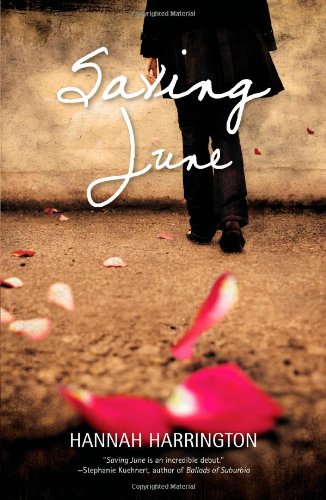
Saving June

‘If she’d waited less than two weeks, she’d be June who died in June. But I guess my sister didn’t consider that.’ 

Harper Scott’s older sister has always been the perfect one so when June takes her own life a week before her high school graduation, sixteen-year-old Harper is devastated. Everyone’s sorry, but no one can explain why. 

When her divorcing parents decide to split her sister’s ashes into his-and-her urns, Harper takes matters into her own hands. She’ll steal the ashes and drive cross-country with her best friend, Laney, to the one place June always dreamed of going California. 

Enter Jake Tolan. He’s a boy with a bad attitude, a classic-rock obsession and nothing in common with Harper’s sister. But Jake had a connection with June, and when he insists on joining them, Harper’s just desperate enough to let him. With his alternately charming and infuriating demeanour and his belief that music can see you through anything, he might be exactly what she needs. 

Except June wasn’t the only one hiding something. Jake’s keeping a secret that has the power to turn Harper’s life upside down again.


So, I went into this expecting great things.  Glowing review after glowing review appeared on my Goodreads feed.  The premise was intriguing and fantastic.  People were even comparing Hannah Harrington to authors such as Melina Marchetta.

But despite that, I was a bit skeptical.  I'm always a bit skeptical when beginning books as praised as this one, like some part of me is mentally preparing for it not to be as amazing as everyone has claimed.  I don't like being let down.

Luckily, Saving June did anything but.

 I don't know exactly what to say about this book.  I don't know how to describe it.  I don't think I can even begin to communicate the rare and beautiful mix of music and love and anger and humor and loss that make up this brilliant little book.  So I'm just going to ask you to read it.  Maybe you'll be able to describe this better than I ever could.

Five solid stars.  Speechless had better come out soon, because the world needs more of this woman's genius.

Sunday, November 13, 2011

How to Save a Life

Jill MacSweeney just wants everything to go back to normal. But ever since her dad died, she's been isolating herself from her boyfriend, her best friends--everyone who wants to support her. You can't lose one family member and simply replace him with a new one, and when her mom decides to adopt a baby, that's exactly what it feels like she's trying to do. And that's decidedly not normal. With her world crumbling around her, can Jill come to embrace a new member of the family?

Mandy Kalinowski knows what it's like to grow up unwanted--to be raised by a mother who never intended to have a child. So when Mandy becomes pregnant, she knows she wants a better life for her baby. But can giving up a child be as easy as it seems? And will she ever be able to find someone to care for her, too?

Critically acclaimed author and National Book Award finalist Sara Zarr delivers a heart-wrenching story, told from dual perspectives, about what it means to be a family and the many roads we can take to become one.


I wasn't really sure what I'd think about this book.  I got it because I'd heard great things about it, and I loved the cover--it's not one of those covers I'd necessarily call "gorgeous," it's just so simple and neat and completely fitting.  

But the description didn't sound like my normal type of read. And when I first started reading it, I was a little "Ehhh, not sure about this."  

I kept reading. And I'm really glad I did.

Sara Zarr's writing, her characters, the plot, and this book in general can be described by two words: simply beautiful.  Zarr doesn't go extravagant; her writing is simple, her world is simple, her plot is simple, and her characters . . . they're not simple so much as they don't have that glossy "otherness" to them that many fictional characters do.  Zarr's characters are real, honest-to-G-d people.

But it was perfect. Because this book didn't need fanciness. It didn't need beautiful prose or a hugely complicated plot or characters designed to make readers fall in love with them.  It needed a sort of frankness to it, a realness, and that's what it had.

While I loved this whole book, my favorite part was Zarr's characters.  I loved Mandy almost from the start, and I adored Robin, and Ravi(<3), and Dylan.  But I wasn't so sure about Jill.  In fact, I thought I was going to hate her.  I mean, she was cruel, she was mistrustful, she shut everyone out, even when they were trying to help. Why would I like that?

Because Jill was a real person. A real, broken person just trying to cope with loss and change and who she was.  Because beneath the cruelty and mistrustfulness and all the angry words and actions, there was beauty and determination and the strength to keep going.

Then there's Mandy.  I just . . . I was torn this whole book between wanting to hug her and high five her.  She is also a broken character, though for a very different reason, and despite everything she's been through, she still has such an . . . innocence about her, this child-like wonder and, as Jill called it, "kookyness" that was just so beautiful and adorable and fantastic.

Usually it's hard to like two love interests, but I managed to love both Ravi and Dylan(though I happened to prefer Ravi).  Just like with Zarr's main characters, these are not the type of people you dream about at night.  They're not ridiculously gorgeous with supernatural powers and snappy one-liners and awesome accents.  But they're real.  I feel like that's the word I keep using: real. Zarr understands how humans really are better than almost any author I've seen.

And lastly, Robin.  All I will say is that I wish I had a mother as awesome as her.

This story is told in dual POVs--Jill and Mandy.  I'm a little iffy on multiple POVs in stories. Sometimes it really works, sometimes it really doesn't.  In this book, it really worked.  Even if they weren't in different fonts, I could've flipped to any given page, read a paragraph, and told you without a doubt who was the narrator.  The voices were incredibly distinct, and I never looked forward to one POV more than another.  Both were great to read and critical to the plotline.

As far as the plot is concerned, well, I don't really want to say much.  I feel like it's the sort of thing you should just read for yourself.  All I'm gonna say is  that I loved the ending. You all know I'm a sucker for happy endings.

This book is most definitely five stars. Go read it.


Monday, October 24, 2011

Looking for Alaska

First friend. First girl. Last words.


A deeply affecting coming-of-age story, Looking for Alaska traces the journey of Miles Halter, a misfit Florida teenager who leaves the safety of home for a boarding school in Alabama and a chance to explore the "Great Perhaps." Debut novelist and NPR commentator Green perfectly captures the intensity of feeling and despair that defines adolescence in this hip, shocking, and emotionally charged work of fiction.

Miles has a quirky interest in famous people's last words, especially François Rabelais's final statement, "I go to seek a Great Perhaps." Determined not to wait for death to begin a similar quest, Miles convinces his parents to let him leave home. Once settled at Culver Creek Preparatory School, he befriends a couple of equally gifted outcasts: his roommate Chip―commonly known as the Colonel—who has a predilection for memorizing long, alphabetical lists for fun; and the beautiful and unpredictable Alaska, whom Miles comes to adore.

The kids grow closer as they make their way through a school year filled with contraband, tests, pranks, breakups, and revelations about family and life. But as the story hurtles toward its shattering climax, chapter headings like "forty-six days before" and "the last day" portend a tragic event―one that will change Miles forever and lead him to new conclusions about the value of his cherished "Great Perhaps."


This was one of those books.


One of those books where I can acknowledge that it has faults--it's his debut novel, how could it not?--, where I can acknowledge that this could've been even better than it was, yet it was so moving, so powerful, so thought-provoking and beautiful, that you ignore those faults.  It's not that you forget them; if asked, I could still produce a few things that might've been changed.  No, it's just that they don't seem significant anymore. Faults? Who cares about faults? Alaska had faults. Alaska had many faults, and that was what made her Alaska. These faults are what make this book Looking for Alaska, and its beauty and overall message are what make this a five star book. A must read. A classic.


I will leave you with this:


“Thomas Edison's last words were 'It's very beautiful over there'. I don't know where there is, but I believe it's somewhere, and I hope it's beautiful.” 


Tuesday, October 4, 2011

Will Grayson, Will Grayson

It's not that far from Evanston to Naperville...


One cold night, in a most unlikely corner of Chicago, two teens—both named Will Grayson—are about to cross paths. As their worlds collide and intertwine, the Will Graysons find their lives going in new and unexpected directions, building toward romantic turns-of-heart and the epic production of history’s most fabulous high school musical.


Hilarious, poignant, and deeply insightful, John Green and David Levithan’s collaborative novel is brimming with a double helping of the heart and humor that have won both them both legions of faithful fans.


I haven't fooled myself about why I read this book now, not some later time.  Yes, I really wanted to read another John Green book. But I could've read Looking for Alaska or Paper Towns.  No, I read this book in particular as a somewhat silly teenage rebellion against my dad, who had both expressed his disapproval of gay marriage and insulted John Green in the same discussion a week ago.  But I'm glad I read it.   I had not read any of Levithan's work prior to this, and I'd only ever read John Green's third person, so I was going into this somewhat blind.  While I didn't love it quite as much as An Abundance of Katherines, I was not disappointed.

Writing
It's interesting, seeing how writing as different as John's and David's could work together so well.  
Though it's slightly different from his third person, John's first person is still funny and smooth reading and thoughtful with excellent dialogue. It never tripped me up, and it was really easy to get lost in it as I read.
David's . . . I'm going to be honest, I thought I would hate it at first.  I mean, the capitals.  The lower case letters were murder for my OCD.  I could barely stand them. But then, as the book progressed, I slowly grew used to them. And really, they were sort of perfect for Will's character.
Also, the train-of-thought feeling his writing often has. That bugged me at first, too.  But like the capitals, it was fitting, and I got used to it. By the end of this book I could could say quite comfortably that I liked David Levithan's writing.
Good, solid writing for this one.

Characters
I'm going to cover three characters: John's Will Grayson, David's Will Grayson, and Tiny Cooper.
So, the John Green Will Grayson. I really liked him.  John Green definitely has a talent at creating characters whose narrative you can just slip into, who you can fall in love with even though they're not the typical "hawt" males of YA today.  His voice was very clear, and he almost never frustrated me, which is saying something.  I was rooting for him. I root for characters I like.
Now, David's Will Grayson. Similarly to the writing, I thought I was going to hate him at first.  He was just so angry and depressed that I was sitting there waiting for his chapters to end.  But as the book went on, he  grew. Both the Will Graysons grew, changed, evolved.  And while I can't say I was in love with this Will Grayson by the end of the book, I understood him. And see, that's really the important thing.  I discovered this in Thirteen Reasons Why.  You don't have to like these sort of characters. They don't need your liking. You just need to understand them and why they are the way they are, and I understood this Will Grayson by the end.  That's what matters.
Finally, we come to . . . Tiny Cooper.    Some have argued that this isn't really the story of two Will Graysons, this is the story of Tiny Cooper. And they are kinda right.  Everything sort of revolves around him in a way.  This huge, hugely gay boy who acts like a child, falls in love in a flash, and, cheesy as this sounds, has a heart even bigger than his rather enormous stomach.  
Sometimes I really loved Tiny and wanted to give him a huge hug, and sometimes I wanted to slap him.  Like when he talked about Will to Gary, and then seemed almost offended that Will was offended by what he's said. Well, I know I'd certainly be offended if my friend said something like that about me. And the fact that he didn't apologize for it.  But there was something so sincere and sweet about him most of the time that's so rare these days, and that I loved.  Tiny Cooper was definitely a very well-developed character, at the least.
For the most part, the rest of the characters were very good. I really liked Jane. I think she complimented Will very well, and I like how John Green's girls are always more awesome in their personalities than their looks.
One last thing: I congratulate the two of them on keeping the characters pretty consistent throughout the chapters.  Obviously the two Will Graysons saw the characters different ways, but they were very steady throughout the book.
Both John and David have a talent with characters, and considering this novel was mostly about the characters and their journeys, that's definitely a good thing.

Plot
The thing is . . . there wasn't an exceptionally strong, overall plot.  This book was not about the plot. It was about the characters, how they interacted, how they grew, the journeys they took and where those took them.  It's about love and tolerance and truth.  Yes, I did think several of the romances happened too fast, and yes, the musical thing could've been focused on a bit more before the musical itself, but in the overall picture of this "plot," that doesn't really matter.  Because these characters changed so much and learned so much in the space of 310 pages, and that's what does matter.

Overall
I really enjoyed this book.  While it wasn't one of those books that I'd say you can't live without reading, that I will remember forever and ever, it made me laugh, it made me smile, and it made me think, and that's what I ask of in a book.
Four stars.